News
From "Wild" to "Polished": Is Generative AI Losing Its Artistic Edge?
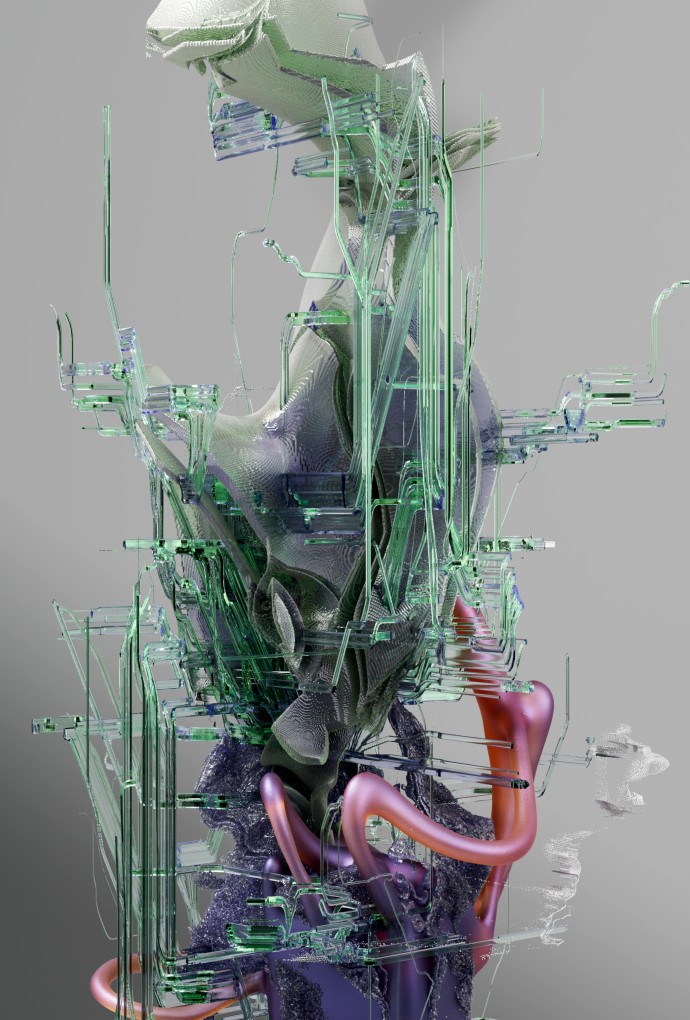
New Publication! Our researcher Mariya Dzhimova and Dr. Benedikt Zönnchen published a chapter in the newly released book, Artificial Intelligence in Creative Industries , published by Routledge.
12/04/2026
From "Wild" to "Polished": Is Generative AI Losing Its Artistic Edge?
In the late 2010s, AI art was a world of "glitches," "hacks," and surprising digital errors that fascinated the art world. Today, it's a mainstream product that can generate a "perfect" image with a single click. But is this move toward perfection actually killing the creativity that made AI art exciting in the first place?
In a new chapter titled "From an Experimental Technology to a Mainstream Product", researchers at MUC.DAI and the HMTM Mariya Dzhimova and Benedikt Zönnchen explore the paradox of generative AI. They argue that as AI becomes more user-friendly and efficient, it may be losing its appeal as a true artistic medium.
The Death of the "Happy Accident"
Early AI artists didn't just use AI to save time; they treated it like a craft. They spent hours coding, curating data, and "working the model against the grain" to find unexpected results, bringing forth the artwork by negotiating its form in a process with friction. The unpredictability was seen as a form of expression in which the artist works against the artwork and vice verca.
However, the authors note that recent shifts have changed the game:
• The "One-Click" Problem: Modern tools like Midjourney simplify complex processes into text prompts, which—while accessible—actually reduce the artist’s direct control over the machine's inner mechanics.
• Mainstream Aesthetics: Modern models are trained to be "accurate," often defaulting to polished, stereotypical "pretty" visuals that avoid the weird, experimental glitches artists love.
• The "AI Slop" Flood: As the technology becomes a mainstream product used by millions, the "hype" and novelty are fading, replaced by a saturation of low-effort content often referred to as "AI slop".
The Future of the Avant-Garde
The research raises a critical question: if AI is designed to follow instructions perfectly, can it still be used to create something truly "new"? Dzhimova and Zönnchen suggest we are at a crossroads where AI art might either become a "naturalized" tool hidden in the background or require a new kind of artistic "avant-garde" to subvert the now-mainstream technology.
„As generative AI becomes more accurate or optimized, it seems to simultaneously limit the possibility of creating or opening up new possibilities,“
the authors conclude.
A Broader Look at AI in Culture
This chapter is part of the newly released book, Artificial Intelligence in Creative Industries, published by Routledge. The volume, edited by Francisco Tigre Moura and Caterina Moruzzi, brings together a diverse range of perspectives on how AI is reshaping music, design, and the broader cultural landscape.
The authors wish to thank the editors for their leadership in compiling this essential collection. We encourage readers to explore the other chapters in the book, which offer invaluable insights into the ethical, legal, and creative implications of our new AI-driven reality.
Read the full Open Access chapter and the complete book here: https://doi.org/10.4324/9781003606802